
Opalized Petrified Wood
Opalized petrified wood forms when opal, rather than quartz, replaces the original organic structure of the wood during fossilization. This type is less common than typical silicified petrified wood and is often recognized by differences in texture, density, and in some cases, translucency.
While all petrified wood undergoes mineral replacement, the presence of opal changes both the appearance and behavior of the material. These differences are not always obvious from the outside, and identification often depends on how the material responds when cut or examined closely.
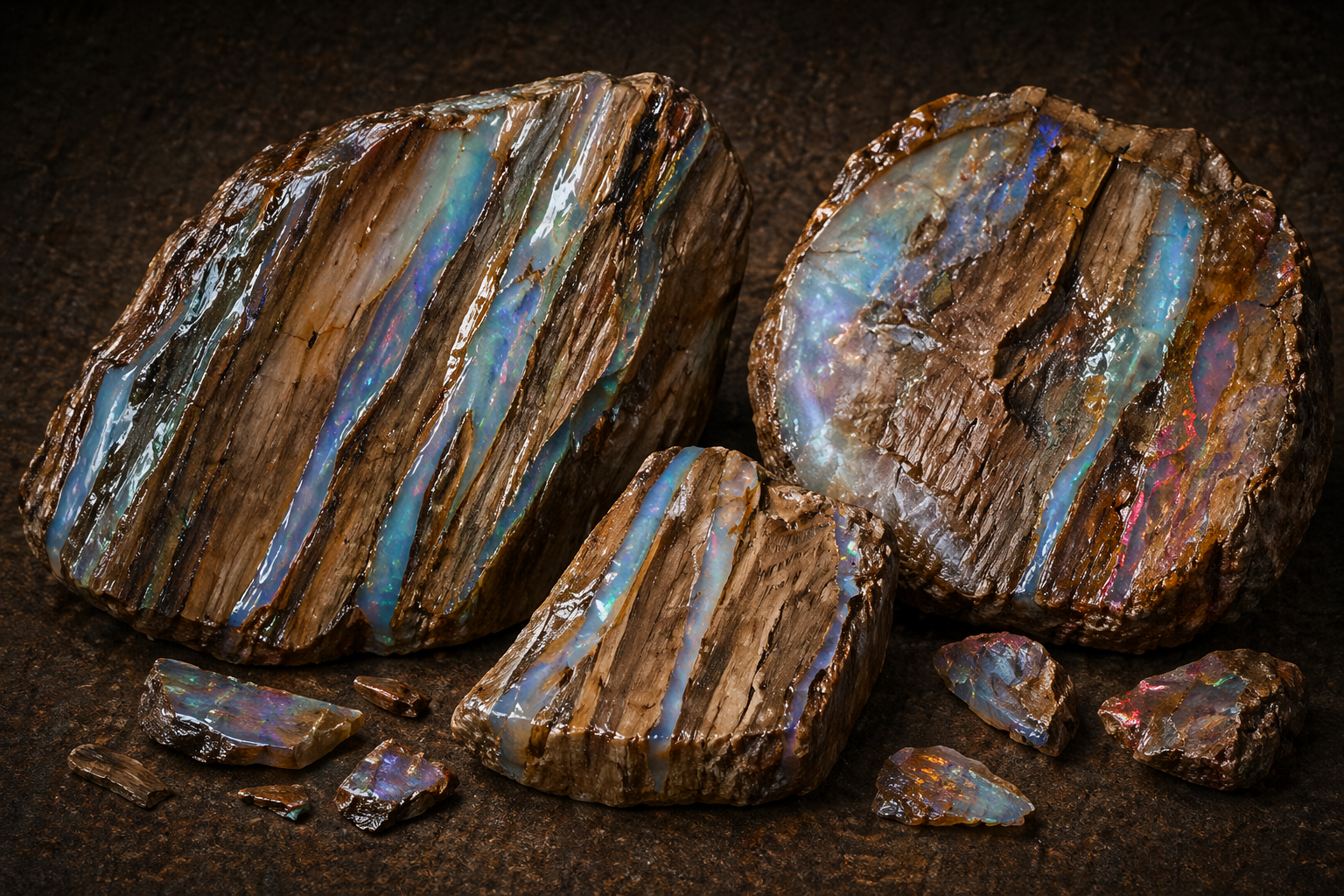 How Opalized Petrified Wood Forms
The formation process is similar to other types of petrified wood, but with a key difference in mineral composition.
After burial, mineral-rich water moves through the wood. In most cases, this water carries silica that eventually forms quartz. In opalized specimens, the silica remains in an amorphous form and deposits as opal instead.
This typically requires:
- A consistent supply of silica-rich water
- Conditions that prevent full crystallization into quartz
- Stable burial over long periods
Because these conditions are more specific, opalized petrified wood is less frequently encountered than silicified material.
What Makes It Different from Typical Petrified Wood
The primary difference lies in the internal composition.
Quartz-based petrified wood is crystalline and highly stable. Opal, by contrast, is not fully crystalline and can behave differently over time.
In practical terms, opalized petrified wood may:
- Feel slightly less dense in some areas
- Show more variation in hardness
- Respond differently to cutting and polishing
These differences are often subtle and may only become apparent when working with the material directly.
Appearance and Visual Characteristics
Opalized petrified wood does not have a single consistent appearance.
Some pieces are relatively opaque and resemble typical petrified wood, while others may show:
- Areas of slight translucency, especially in thinner sections
- A smoother or more glass-like surface when polished
- Subtle internal variation rather than strong banding
It is important to note that not all opalized specimens display play-of-color. In many cases, the material is visually similar to quartz-based petrified wood, and identification depends on composition rather than visible effects.
Stability and Long-Term Behavior
One of the key considerations with opalized petrified wood is stability.
Quartz-based petrified wood is generally very stable and resistant to environmental changes. Opal, depending on its type and water content, can be more sensitive.
In some specimens, this may lead to:
- Fine surface cracking over time
- Changes in appearance if exposed to extreme dryness or temperature variation
- Greater care needed during cutting and handling
Not all opalized material is unstable, but variation exists, and it is not always predictable.
Working with Opalized Material
Cutting and polishing opalized petrified wood requires a slightly different approach than working with quartz-based material.
Because of potential variation in hardness and structure:
- Cuts should be made slowly and with consistent pressure
- Water cooling is essential to reduce stress and heat
- Surfaces should be examined carefully for internal fractures
Some pieces respond well to polishing and reveal smooth, even surfaces. Others may show irregularities that reflect differences in mineral deposition.
Collectors often evaluate smaller sections before committing to larger cuts.
Where Opalized Petrified Wood Is Found
Opalized petrified wood has been found in several regions, although it is less commonly associated with large, well-known deposits.
Occurrences have been reported in:
- Parts of the western United States
- Australia, where opal deposits are more common
- Other regions with silica-rich groundwater conditions
The presence of opal in petrified wood depends more on local chemical conditions than on a specific geographic location.
How It Compares to Agatized Material
Opalized and agatized petrified wood are sometimes compared because both involve silica, but they form differently.
Agatized petrified wood develops banded structures due to layered deposition of silica that crystallizes into quartz. This often produces strong visual contrast and well-defined patterns.
Opalized petrified wood, by contrast, lacks this crystalline structure. It may appear more uniform internally, with less pronounced banding but a different surface quality when polished.
In some specimens, both types of mineralization may be present in different areas, reflecting changes in conditions during fossilization.
Rarity and Collector Interest
Opalized petrified wood is generally considered less common than standard silicified material, but rarity depends on how it is defined.
Not all opalized pieces are visually distinctive, and not all are rare in a strict sense. What often attracts collector interest is:
- The presence of unusual internal structure
- Differences in texture compared to typical petrified wood
- The relative difficulty of finding consistent, high-quality material
As with other types, individual characteristics matter more than the category alone.
Identifying Opalized Petrified Wood
Identifying opalized petrified wood can be challenging without close examination.
Surface appearance alone is not always reliable. Instead, identification may involve:
- Observing how the material reacts when cut or polished
- Noting differences in density or hardness within the piece
- Comparing the internal structure to known quartz-based material
In some cases, more precise identification may require laboratory analysis, especially when visual differences are minimal.
When It Is Worth Seeking Out
Opalized petrified wood is not always the most practical choice for every use.
For collectors interested in variation and less common material, it can be an interesting addition. For applications that require maximum stability, such as large slabs or structural use, quartz-based petrified wood is often preferred.
The decision depends on whether the goal is visual distinction, geological interest, or long-term durability.
Variation in the Fossilization Process
Opalized petrified wood represents a variation in the fossilization process where silica did not fully crystallize into quartz. This difference affects how the material looks, feels, and behaves.
While it is less common than typical petrified wood, its characteristics are not always immediately visible. Careful observation and comparison are often required to understand what sets it apart.