
How to Identify Petrified Wood
Identifying petrified wood requires understanding both its geological transformation and its physical characteristics. While it may resemble ordinary wood at first glance, petrified wood is actually stone, formed over millions of years through mineral replacement.
With the right approach, you can reliably distinguish real petrified wood from common rocks, modern wood, or imitations.
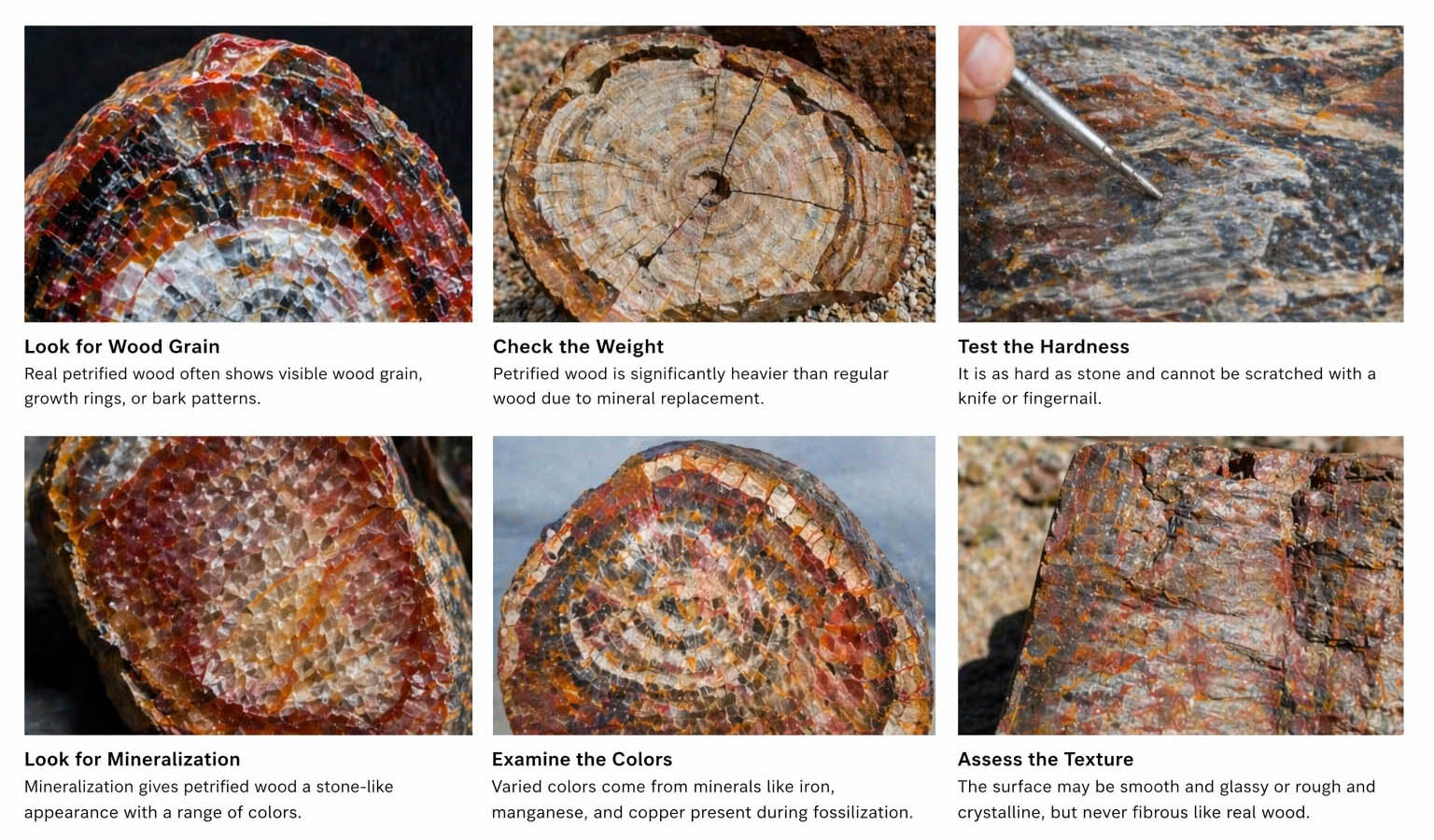 Key Characteristics of Real Petrified Wood
Authentic petrified wood has a combination of features that make it distinct.
1. Visible Wood Grain
One of the most recognizable traits is preserved wood structure.
- Growth rings may still be visible
- Grain patterns often resemble cut lumber
- Bark textures may appear on the exterior
These features are not superficial, they are part of the fossilized structure.
2. Weight and Density
Petrified wood is significantly heavier than normal wood.
- Feels like stone, not wood
- High density due to mineral replacement
- Even small pieces can feel surprisingly heavy
If it feels light like regular wood, it is not petrified.
3. Hardness
Most petrified wood is composed primarily of quartz.
- Hardness similar to quartz (around 7 on Mohs scale)
- Cannot be scratched with a fingernail or knife
- Can scratch glass in some cases
This is one of the most reliable indicators.
4. Color and Mineral Patterns
Color variation is a result of minerals present during fossilization.
- Reds, yellows, and oranges (iron)
- Purples and blues (manganese)
- Blacks and dark tones (carbon)
- Banding or crystallization in some specimens
Natural color variation is often irregular and complex.
5. Stone-Like Texture
Despite looking like wood, petrified wood behaves like rock.
- Smooth when polished
- Can show crystalline structure internally
- Breaks like stone, not like wood
Simple Tests You Can Do
You don’t need specialized equipment to evaluate most pieces.
Scratch Test
Try lightly scratching an inconspicuous area with a steel object.
- Real petrified wood should resist scratching
- If it scratches easily, it may not be petrified
Weight Test
Compare the piece to a similarly sized piece of wood.
- Petrified wood will feel much heavier
Visual Inspection
Look closely at the structure.
- Are the grain patterns consistent throughout?
- Does it look natural rather than painted or artificial?
Temperature Test
Stone retains temperature differently than wood.
- Petrified wood often feels cool to the touch
Common Misidentifications
Many materials are mistaken for petrified wood.
Regular Wood
- Lightweight
- Burns easily
- Lacks mineralization
Stained or Treated Wood
- Artificial coloring
- No mineral structure
- Surface-level appearance only
Patterned Rocks
- May resemble grain patterns
- Lack true cellular structure
- Often uniform rather than organic
Fossilized But Not Petrified
Some fossils preserve shape but not structure.
- Compressed rather than mineral-replaced
- Lack detailed internal grain
Cut vs. Raw Petrified Wood
Petrified wood can appear very different depending on how it is presented.
Raw Pieces
- Rough exterior
- May resemble logs or fragments
- Bark-like texture
Polished Pieces
- Reveals internal color and grain
- Often used for display or furniture
- Highlights mineral patterns
Both forms can be authentic, it’s the internal structure that matters.
Why Origin Can Help Identification
Certain regions are known for distinctive petrified wood.
- Arizona: vibrant reds, yellows, and purples
- Madagascar: large logs and slabs
- Indonesia: varied tones and textures
Knowing the source can provide additional context, but identification should always rely on physical characteristics.
Why Proper Identification Matters
Correctly identifying petrified wood helps you:
- Avoid purchasing misrepresented material
- Understand the true value of a piece
- Choose specimens that meet your needs
- Build a more meaningful collection
For collectors and buyers, this knowledge is essential.
Where to Find Real Petrified Wood
Authenticity varies widely depending on the source.
When purchasing petrified wood, look for:
- Clear descriptions of origin and characteristics
- Visible grain and mineral detail
- Transparent information about the piece
Is Petrified Wood Heavy or Light?
One of the easiest ways to identify petrified wood is by its weight. Many people are surprised to discover that petrified wood is usually very heavy compared to normal wood of the same size.
Although it still looks like wood, petrified wood is actually stone. During the fossilization process, the original organic material is gradually replaced by minerals such as quartz, silica, calcite, and other compounds. This mineral replacement dramatically increases the density and weight of the material.
Why Petrified Wood Feels Heavy
Normal wood contains air pockets and organic fibers, making it relatively lightweight. Petrified wood no longer contains those lightweight organic structures.
Instead, the wood cells become filled and replaced with minerals over millions of years.
As a result:
- Petrified wood feels dense and solid
- Even small pieces can feel surprisingly heavy
- Large logs can weigh hundreds or even thousands of pounds
- It feels much more like carrying a rock than carrying wood
In many cases, petrified wood weighs close to the same as quartz-rich stone because silica is commonly involved in the fossilization process.
Comparing Petrified Wood to Regular Wood
If you pick up a piece of regular dry wood and a similarly sized piece of petrified wood, the difference is usually obvious immediately.
Regular Wood:
- Lightweight
- Slightly soft
- Often warmer to the touch
- Can float easily in water
Petrified Wood:
- Heavy and dense
- Cool to the touch
- Hard like stone
- Often sinks in water due to mineral content
This weight difference is one of the fastest field identification methods collectors use.
Can Petrified Wood Ever Feel Light?
Some smaller or partially mineralized specimens may feel lighter than expected, but genuine fully petrified wood should still feel noticeably heavier than ordinary wood.
Factors that affect weight include:
- The type of minerals present
- How complete the petrification process was
- Internal voids or cracks
- Moisture content
- Overall density of the original wood species
Highly silicified petrified wood is typically among the heaviest and hardest varieties.
Using Weight to Identify Real Petrified Wood
Weight alone should not be the only test, but it is an important clue.
If a specimen:
- Looks like wood
- Feels unusually heavy
- Has visible grain patterns
- Resists scratching
- Feels cool like stone
…it is much more likely to be authentic petrified wood.
If it feels light like ordinary lumber, it is probably:
- Modern wood
- Driftwood
- Resin or artificial replica
- Poorly mineralized material
Collectors, rockhounds, and fossil enthusiasts often use the “lift test” as one of the first ways to evaluate a specimen before performing more detailed examination.